How to Become a Funded Trader

This is where funded trader program come in, allowing you to trade with a sizable account without risking your personal account.
The proprietary (prop) trading firms fund skilled traders in exchange for a share of the profits.
With advanced trading platforms and technology making markets more accessible than ever, prop trading and funded accounts have become a sought-after career path
Key Takeaways
- Funded traders use a prop firm’s capital to trade without putting the full trading capital at risk from their personal account.
- Getting funded requires going through an evaluation phase, and after passing, traders must continue meeting risk limits and other firm rules to keep their account.
How Funded Trading Programs Work
Funded trading programs work as a corporate screening process, filtering for traders who can hit precise trading targets while strictly protecting the firm's downside and following risk rules. To accommodate different experience levels and risk tolerances, proprietary firms typically structure their entry pathways into three distinct models.
Step 1: Evaluation Phase
Prop firms offer different funding paths that allow traders to demonstrate their skills and qualify for a funded account. These commonly include one-step evaluations, two-step evaluations, and instant funding programs.
2-step challenge
The 2-step challenge is the most common, where traders must pass two phases to qualify for a funded account.
Profit targets and drawdown limits vary by firm and program. For example, Top One Trader's current 2-Step Pro requires an 8% profit target in Phase 1 and 5% in Phase 2, with a 4% daily loss limit and 9% static maximum loss.
The main focus is on demonstrating the ability to make profits while adhering to financial risk management rules. Traders must avoid breaching the daily drawdown and overall drawdown limits during both phases.Minimum trading days for a two-step evaluation program vary by proprietary trading firm, typically ranging from no minimum up to 5 trading days per phase.
1-step challenge
Some firms also offer a 1-step challenge, where traders only need to pass one phase to become eligible for funding, but they still must hit profit targets and remain under maximum drawdown requirements.
Instant funding accounts
Instant funding accounts have become very popular in recent years as they cut the waiting time to get funded accounts.
These accounts allow traders to bypass the evaluation process and start trading right away, provided they follow the firm's rules and meet performance criteria.
Evaluation Rules
The fundamental goal of these challenges is to prove that a trader can consistently hit profit targets without breaching drawdown limits. In addition to the profit and drawdown requirements, there are other rules that vary between different firms and programs.
Some firms prohibit trading during high-impact news events or the use of expert advisrs (EAs) or high-frequency trading. Traders must thoroughly read and understand the firm's policies before entering a challenge to ensure they comply with all guidelines.
Step 2: Become a Funded Trader
Once traders successfully pass the evaluation challenge, they are granted access to a funded trading account with the capital they selected at the beginning.
From here, traders can start trading with the firm's capital and share in the profits they generate. The profit split typically ranges from 80% to 100%, depending on the firm's policies and specific conditions.
However, traders must continue adhering to the firm's trading rules to maintain their funded status.
Step 3: Scaling Plan
A professional trader with a proven track record can scale their account after meeting the required performance targets. The trader must achieve 25% in total gains over three months, with at least 8% earned in each month. Once these results are verified, the initial account balance increases by 25%, giving the trader access to a larger account size.
Getting funded is exciting, but choosing the right prop firm is just as important! Top One Trader provides you with the right tools and access to real trading capital in a supportive environment, helping you maximize opportunities without risking your own money.
Developing the Skills to Get Funded
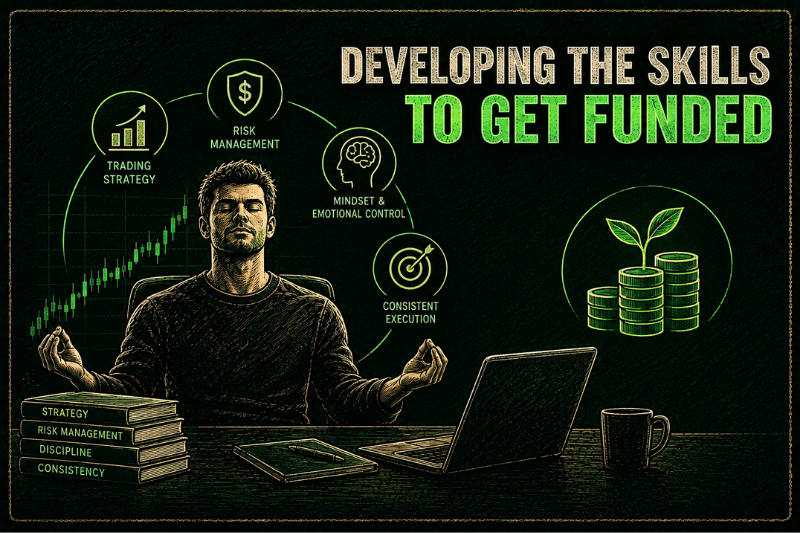
Becoming a funded trader requires more than just technical knowledge of the financial markets. it demands a solid trading plan, strict risk management, and discipline.
These are the key principles that prop trading firms look for when evaluating traders for funded trading accounts. For traders aiming to succeed, developing these key skills are essential.
Trading strategy
A successful trader understands that a trading strategy is not just a tool for entering and exiting the market, it's a comprehensive plan that incorporates risk tolerance, market analysis, trade management and responsible trading. Without a robust strategy, achieving consistent profits and minimizing unnecessary losses becomes challenging.
To succeed and secure funding, a trader must develop a trading style with a proven edge in the market. This means thoroughly building and backtesting the strategy across multiple markets and over a significant period to confirm its profitability.
A strong strategy should have clearly defined and strict rules for market analysis, time frames used, identifying precise entry and exit points, and maintaining a solid reward-to-risk ratio for each trade.
By following these principles, traders can maximize their edge, improve consistency, and increase their chances of passing prop firm challenges.
Risk management
One of the most essential components of any funded trader program is risk management. Without it, even the most profitable strategies can fail.
Funded traders must understand when to reduce their positions, when to step away from the market, and how to set stop-loss orders to protect their capital.
Since most prop trading firms impose strict drawdown risk limits, maintaining discipline with risk management is crucial to avoiding significant losses that could result in losing funding. Most firms enforce a daily drawdown limit of 3-5% and an overall drawdown limit of 6-10%, meaning traders must structure their risk management around these parameters.
To stay funded, protect their capital, and survive drawdown periods, traders should risk between 0.25% and 0.5% per trade, ensuring they can withstand inevitable losing streaks while maintaining long-term profitability. Not following strict risk management strategies could lead to blowing the funded account.
Mindset & Emotional Control
To succeed in trading, especially with funded accounts, mastering emotional control, discipline, and patience is essential. Many traders rush to get funded quickly, which often leads to emotional instability, impulsive decisions, over-risking, entering low-quality trades, and revenge trading, all of which increase the risk of losing their account.
To avoid this, traders must stick to their strategy, risk small per trade, and focus on long-term consistency rather than short-term gains.
Developing good habits such as patience, discipline, following a strict trading plan, journaling trades, and embracing losses as part of the game helps traders stay funded, control emotions, and grow their capital sustainably.
Succeeding as a Funded Trader
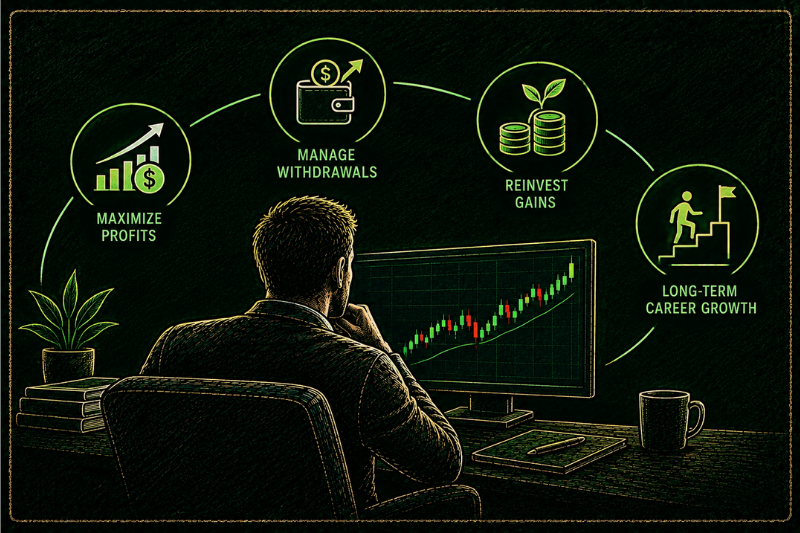
Once a trader has successfully passed the evaluation and is awarded a funded trading account, the next challenge is managing that account effectively.
Funded traders need to continue applying their trading strategy and managing risk, but an important part of the funded stage is also knowing how to handle withdrawals and reinvest gains.
Traders can withdraw profits once they meet the firm's payout requirements, while some may choose to leave part of their earnings in the account to support future growth. The right approach depends on the trader's goals, the firm's payout structure, and the rules attached to the account.
Long-term development also matters. Funded traders may continue refining their strategies, expanding into different markets, or working toward larger capital allocations through the firm's scaling program.
How to Keep a Funded Account
Passing the evaluation does not mean the rules disappear. Funded traders still need to comply with the account's ongoing requirements to keep access to their funded capital.
Some of the main reasons a funded account can be lost include:
- Breaching drawdown limits: Exceeding daily or overall drawdown limits can result in the account being closed.
- Inactivity: Top One Trader requires traders to place at least one trade every 30 days. Failing to meet this requirement can result in an account breach.
- Breaking trading rules: Violating rules around expert advisors, copy trading, or other prohibited trading practices can result in losing the account.
- Failing to follow account-specific conditions: Different account types may have different requirements, so traders need to continue following the rules attached to their specific program.
For a deeper breakdown, see what happens if you blow a funded account.
Conclusion
Funded trading accounts offer a unique opportunity for traders to access significant capital without risking their own money. However, passing an evaluation and securing funding is just the beginning. To succeed, traders must demonstrate strong trading skills, disciplined risk management, and emotional control while adhering to the firm's rules.
By choosing the right prop firm, understanding the evaluation process, and maintaining consistency in execution, traders can be successful. Whether through 2-step challenges, 1-step challenges, or instant funding accounts, the key to long-term success lies in strategic decision-making and risk management.
Ready to take your trading career to the next level? Sign up for a funded account with Top One Trader today and start your journey with the right support and tools!
Why Top One Trader?
There are plenty of firms offering funded trading programs, but Top One Trader gives traders several ways to approach the challenge based on their trading style and goals.
- Choose from different funding paths: Top One Trader offers 1-Step and 2-Step challenges, along with Instant Funding and Instant PRIME options. Account sizes range from $10,000 to $200,000, with scaling options available after funding.
- Keep a larger share of your profits: Funded traders receive an 80% standard profit split on several programs, with options to increase the split to 90% and, on some accounts, 100% through available add-ons.
- Built-in risk controls: Top One Trader uses EquityShield to help limit excessive open risk. The system can automatically close trades when specified equity thresholds are reached, adding another layer of risk control alongside the firm's trading rules.
FAQs
Do you need prior trading experience to become a funded trader?
No, but having a tested strategy, market knowledge, and consistent trading experience can help you meet a prop firm's requirements.
How much does it cost to become a funded trader?
The cost varies by prop firm, account size, and funding model, with traders typically paying an upfront program or evaluation fee.
Can funded traders trade multiple financial markets?
Yes, depending on the prop firm's rules, funded traders may be able to trade forex, stocks, indices, commodities, or cryptocurrencies.
What happens if a funded trader breaks a prop firm's rules?
A rule violation can lead to restrictions, loss of the funded account, or termination of the trading program, depending on the firm's policy.
Is funded trading a full-time career?
Yes, some traders pursue funded trading as a full-time career, while others use it alongside another job or trading activity.