Forex Hedging Explained: Strategies, Examples, and Risks


If you’ve been trading for a while, you’ve probably seen this scenario: you open a position, it moves in your favour, then suddenly reverses. This is common in forex, where prices rarely move in a straight line and are influenced by multiple factors.
These drawdowns can be frustrating and often lead to unnecessary losses. Hedging is one way traders manage this without closing positions too early.
In this guide, you will learn how forex hedging works, when to use it, and how to apply different methods in real market conditions.
Key Takeaways
- Hedging is a risk management technique that reduces exposure to adverse price movements in open positions by opening a second position to balance an existing trade.
- Hedging can help limit losses during drawdowns, but it also reduces potential profits and increases trading costs.
What Is Hedging in Forex?

Hedging in forex means protecting a trade against drawdowns. When you open a position and price moves in your favour, then suddenly reverses, this creates a drawdown and can reduce your profits or turn into a loss. One way traders manage this is through hedging.
Instead of closing the position, you open a second trade that helps balance the risk. If the market moves against your main position, the second trade can reduce the impact of that move.
In most cases, this involves opening an opposite position on the same currency pair. For example, if you are long on EUR/USD and the price starts moving against you, you may open a short position to limit the downside until conditions become clearer.
It is important to keep expectations realistic. Hedging does not remove risk completely; it only helps manage it. You can still lose money, and it can reduce profits if the market moves in your favour. This is why hedging is considered a risk management technique, not a way to generate profits directly.
Why and When Do Traders Use Forex Hedging?
Traders usually hedge when market conditions become less clear, not when everything is obvious. It is mainly used during periods of uncertainty, where price behaviour becomes harder to manage.
During Uncertain Market Conditions
This often happens during:
- High-impact news events → volatility increases and price moves quickly without a clear direction
- Sudden shifts in sentiment → market conditions change unexpectedly
In these situations, holding a position without protection can become risky.
Another common case is when the higher timeframe direction remains valid, but short-term price action starts to move against the trade.
For example, a trader may be long on GBP/USD based on the daily trend, while the 1H timeframe shows short-term bearish pressure after news.
Instead of closing too early, the trader may open a short position to manage the risk until the market becomes clearer.
During Pullbacks Within a Trend
Hedging can also be useful during pullbacks.
Markets move in cycles of impulse and retracement, not in a straight line. Even in a strong trend, positions can face temporary drawdowns during these pullbacks.
In this case, opening an opposite position can help reduce the impact of that move.
Closing the trade might be too early, but holding it without protection can be too risky. This is where hedging becomes useful.
In simple terms, hedging is used when:
- The main idea is still valid
- But short-term market movements create risk
Main Forex Hedging Strategies

There are two main ways traders hedge in the forex market. The first is direct hedging on the same currency pair. The second is hedging using negatively correlated pairs. Both aim to manage risk, but they differ in execution.
Direct Hedging on the Same Currency Pair
Direct hedging involves opening a buy and a sell position on the same currency pair. This balances exposure and reduces the impact of short-term adverse price movements.
For example, a long position may be held based on a higher timeframe trend. If short-term pressure appears, a short position is opened on the same pair. If price drops, the short position helps reduce losses. If the trend resumes, the hedge can be closed.
This method is simple and precise and can help protect against drawdowns, but it is not allowed by some brokers and prop firms.
If you are looking for a prop firm that supports hedging, along with fair rules, educational content, and strong trader support, Top One Trader offers funded accounts designed for disciplined and consistent traders.
Example:
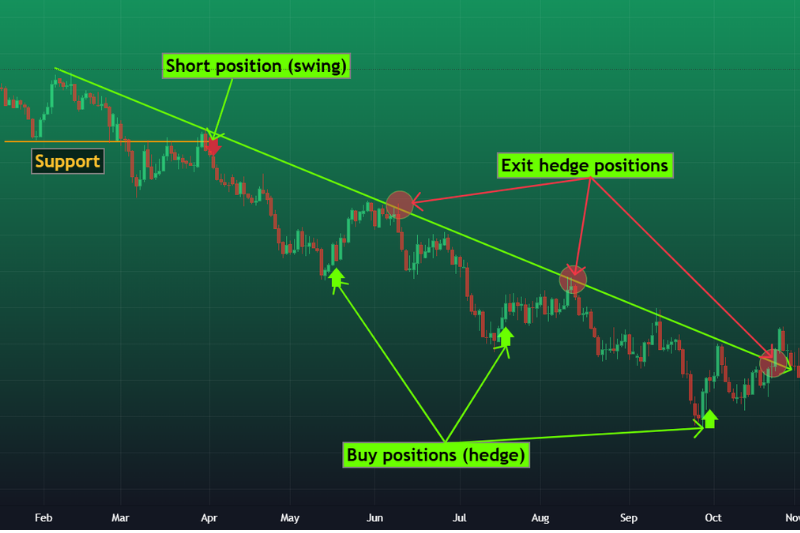
In this example on EUR/USD (daily timeframe), a short position is taken after the price breaks below a support level and retests it, confirming a bearish continuation. Following the move, a descending trendline forms, connecting lower highs and defining the structure of the downtrend.
Within this trend, price creates temporary pullbacks. These pullbacks provide opportunities to open buy positions as hedges near local lows when bullish signals appear.
The hedge positions are then closed as price reaches the trendline, which acts as a dynamic resistance and target zone, while the main short position remains active.
Hedging with Negatively Correlated Currency Pairs
This method uses two different currency pairs that tend to move in opposite directions. A common example is EUR/USD and USD/CHF.
Instead of opening opposite trades on the same pair, a second position is taken on a correlated pair to balance exposure.
For example, if a long position is open on GBP/USD and price starts to move against it, a long position can be taken on USD/CHF. Since the pairs often move inversely, gains in one can offset losses in the other.
This approach is more flexible, but less precise. Correlation is not fixed and can change depending on market conditions.
Example:
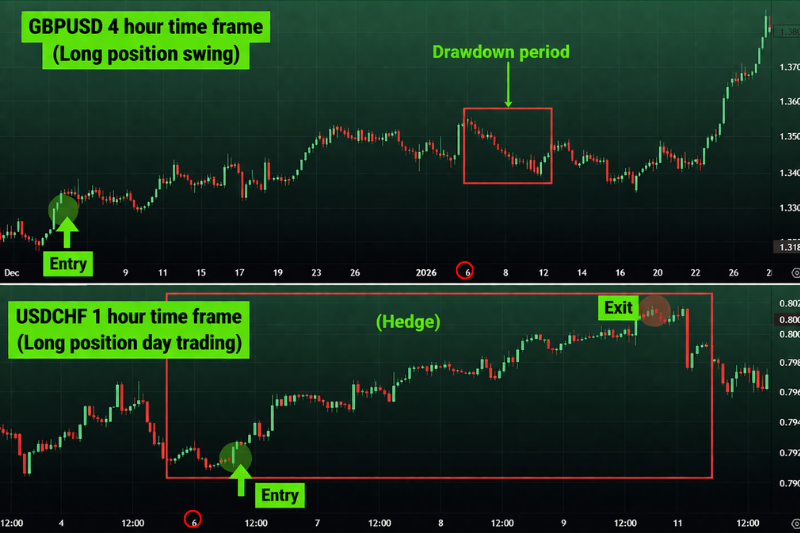
In this example, a long position is taken on GBP/USD on the 4H timeframe based on a swing setup. Price initially moves in favour of the position, with minor pullbacks along the way. On January 6th, price starts a deeper pullback, creating short-term bearish pressure and a drawdown on the position.
At the same time, USD/CHF, which is negatively correlated with GBP/USD, begins to move higher and forms a strong bullish candle. This creates a buy opportunity on the 1H timeframe, which can be used as a hedge against the drawdown on GBP/USD.
Since the two pairs tend to move in opposite directions, the long position on USD/CHF helps offset part of the losses. The hedge is then closed as GBP/USD shows signs of bullish continuation and resumes its original direction.
Hedging Across Different Markets
Hedging is not limited to forex. The same logic can be applied to other markets such as commodities, stocks, and indices.
As long as there is exposure to price movement, a second position can be used to manage risk during uncertain conditions.
Example:
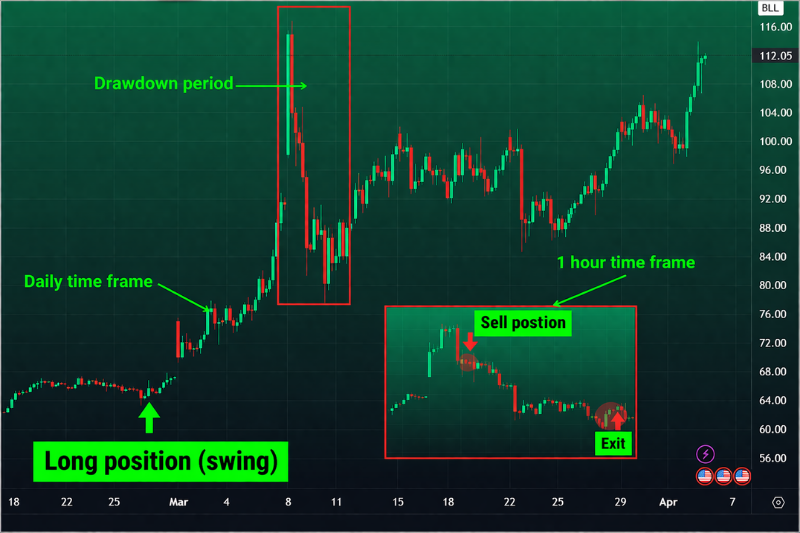
In this example on US Oil (daily timeframe), a long position is taken based on a swing setup. Price moves strongly in favour of the position, then begins to reverse and enters a drawdown phase.
When zooming into the lower timeframe (1H), a strong bearish candle appears, signalling short-term selling pressure. This creates an opportunity to open a short position as a hedge against the drawdown while keeping the original long position active.
The hedge helps reduce the impact of the pullback and is closed once price shows signs of bullish continuation and resumes the higher timeframe direction.
Is Forex Hedging Allowed?
Forex hedging is not treated the same way everywhere. In some regions, it is fully allowed, while in others, there are restrictions on how it can be used.
For example, in the United States, opening buy and sell trades on the same currency pair is restricted.
According to the National Futures Association (NFA), brokers are not permitted to carry offsetting positions in a customer account. As a result, retail traders cannot hold buy and sell positions on the same currency pair, meaning direct hedging is not allowed in practice.
In other regions such as Europe, Asia, and Australia, traders generally have more flexibility. Many brokers allow full use of currency hedging techniques across multiple currency pairs, making it easier to manage exposure to market fluctuations.
The reason behind these rules is simple. Regulators aim to protect traders from excessive costs and overly complex strategies. At the same time, hedging increases trading activity, which can impact execution and costs.
Before applying any hedging strategy, it is important to check:
- platform rules
- country regulations
- execution conditions
Advantages and Disadvantages of Forex Hedging

Like any risk management tool, hedging has both strengths and limitations. It is widely used to manage currency risk and protect positions during periods of currency volatility and market fluctuations.
Advantages
Hedging is often used to manage foreign currency exposure, especially when traders exchange foreign currencies or operate across multiple currency pairs. For larger players, including financial institutions, it plays a key role in stabilising performance during currency fluctuations.
Disadvantages
Hedging does not eliminate foreign currency risk completely. Instead, it redistributes exposure, which means traders still need to monitor overall risk carefully.
Final Thoughts
Forex hedging is a practical tool, but it is often misunderstood. It is not a way to avoid risk completely, but a method for managing currency risk when currency movements become unpredictable.
In the right situation, currency hedging reduces the impact of drawdowns and provides flexibility. In the wrong situation, it can increase costs and reduce clarity.
The key is knowing when to apply it:
- not on every trade
- not without a plan
- Not for profit
- Only for protection against a drawdown
When used correctly, simple forex hedging becomes part of a broader strategy. It supports decision-making rather than replacing it, especially during periods of high currency volatility.
Ready to trade in real market conditions?
Top One Trader provides funded accounts for disciplined traders focused on consistency and long-term performance, with fast payouts, competitive pricing, clear rules, advanced platforms, and a supportive trading community.
FAQ
How does a fair value hedge work in forex?
A fair value hedge protects a position from foreign exchange risk by offsetting price changes. It may involve additional trades or financial derivatives to stabilise value. The goal is not the obligation to profit, but to control exposure.
How are financial derivatives used in hedging?
Some strategies use financial derivatives such as options or forwards. These allow traders to fix a price at a future date, helping manage uncertainty caused by currency fluctuations.
Why is currency hedging used?
Currency hedging is used to limit exposure to exchange rate fluctuations across different situations. In trading, it helps manage open positions during uncertain market conditions.
Outside trading, it is widely used for travel, international payments, and by companies involved in import and export to reduce foreign currency risk. It is one of the key risk management strategies used to control the impact of currency movements.
-1%201%20(1).webp)