Set and Forget Trading Strategy Explained

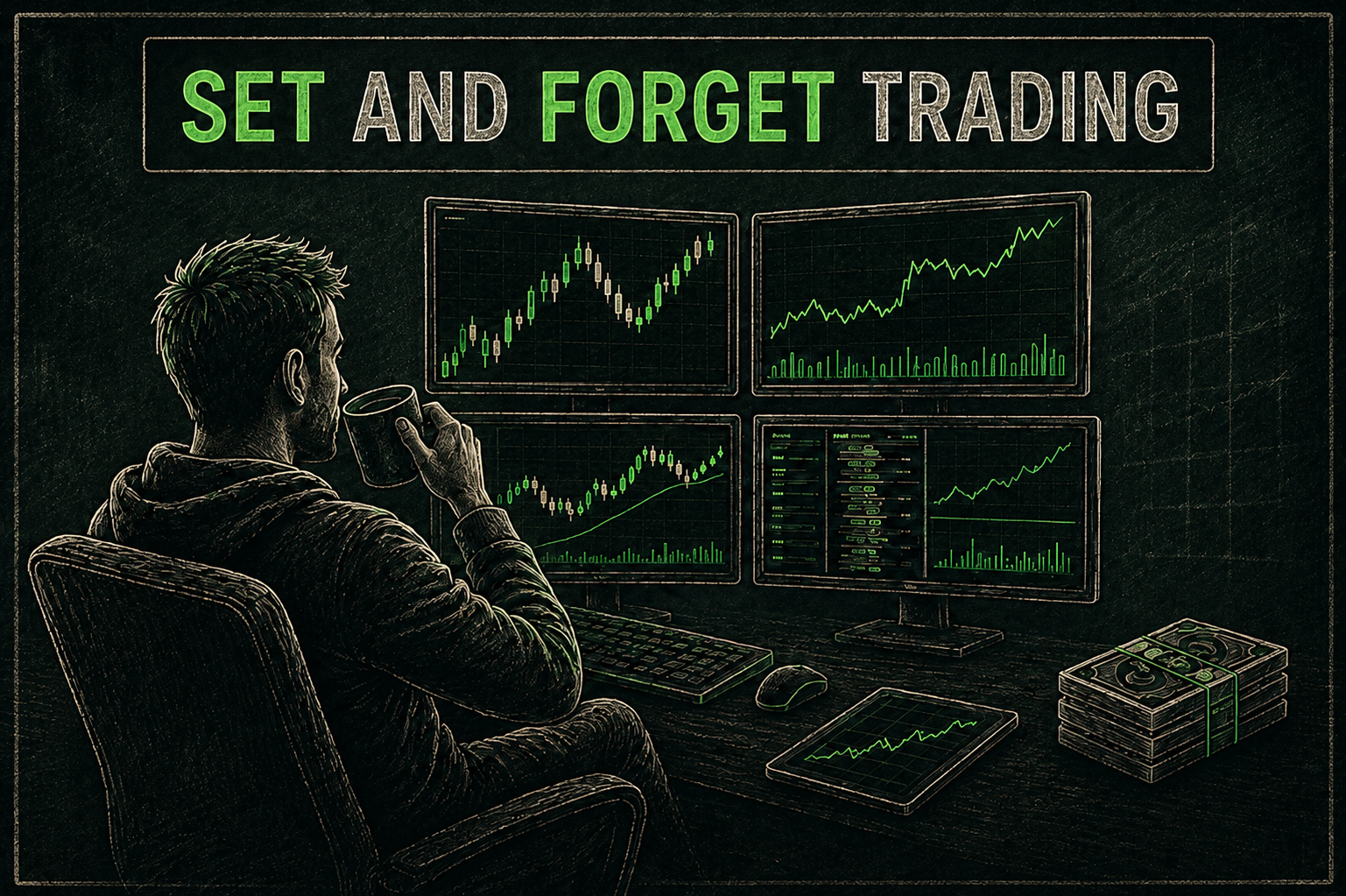
Many traders think spending more time watching charts leads to better results, but that's rarely the case. Constantly checking price movements can be tiring and often leads to emotional decisions. The solution is using a strategy that requires less screen time and simplifies the trading process.
One of the most effective methods is set and forget trading. It offers a structured, less time-consuming process, allowing you to trade confidently with lower stress levels and fewer emotional ups & downs. Traders plan their trades beforehand, and the market does the rest.
In this guide, we’ll break down what set and forget trading means, its core concepts, pros, cons, and how you can apply it to different trading styles, including prop trading.
Key Takeaways
- Set and forget trading means placing an order with a predefined stop loss and take profit, then leaving it untouched until one level triggers.
- It cuts down on screen time and impulsive decisions compared with day trading or scalping.
What Is Set and Forget Trading?
Set and forget trading is a strategy where a trader enters a position with a fixed stop loss and takes profit already in place, then avoids adjusting the trade based on short-term price swings. The method suits traders who have other responsibilities but want effective trading while managing their time.
The approach is very similar to short-to-medium trading methods like swing and position trading. Instead of taking and managing random trades a day, a trader might place one or two well-researched setups on the 4-hour or daily chart, then check back only when the trade needs a real review.
Although it may appear that way to beginners, this approach is not the same as ignoring a trade entirely. Traders still track price action, news events, account risk, and whether the original setup remains valid, but they resist the urge to move stops or targets simply because price wiggled in the short term.
Set and Forget trading helps traders in three important ways:
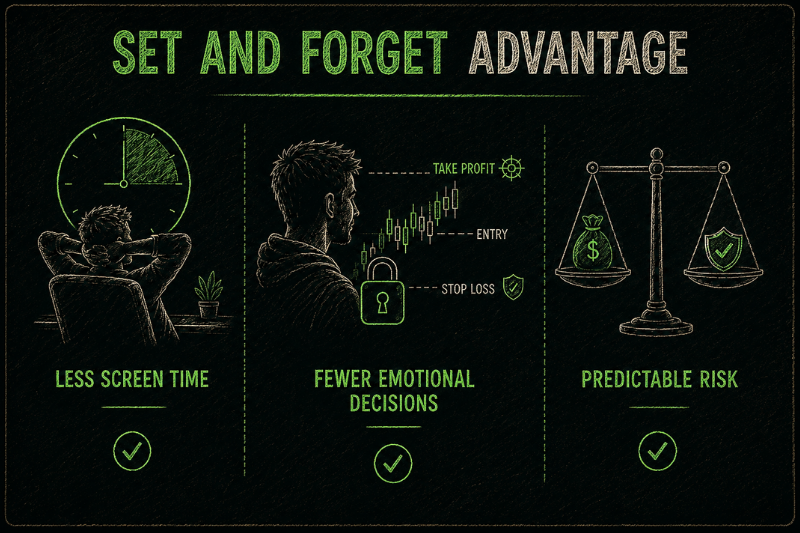
- Less screen time: Entries, stops, and targets are all set in advance, so there's no need to watch charts all day waiting to react to every price move.
- Fewer emotional decisions: Locking in the exit before the trade opens removes the urge to move a stop loss or take profit based on short-term noise or fear.
- Predictable risk: Position size gets calculated from the stop distance up front, so the dollar risk on each trade stays fixed no matter how the trade plays out.
How does set and forget trading work?
Set and forget trading works by defining every exit before the entry goes in, which removes the need for constant decision-making once the trade is live. A trader identifies a setup, defines the entry, sets a stop loss to cap the downside, and sets a take profit to lock in the target gain.
The position size is determined based on the stop distance, ensuring nothing is done randomly. With pre-defined entry, position sizing, stop, and take profit are locked in when the order is placed and left alone.
It is important to understand that the plan gets built before the trade goes live, not during it.
Key Principles of Set and Forget
- Plan before you enter: Planning includes detailed analysis of the asset's technical and fundamental aspects to determine entry, position size, stop loss, and take profit, defined before the order goes live and not adjusted or decided mid-trade.
- No interference: After the entry order executes, strict no emotional interference must be followed. Once the order is placed, price wiggling against it isn't a reason to interfere. Trusting the process and following the plan must be the main objective.
- Favor trending markets on higher timeframes: The strategy needs room to work, so it performs best on higher timeframes, such as the daily or weekly chart, rather than in tight, choppy ranges. This is also a crucial part of the strategic planning.
Set and Forget trade example
GBP/USD breaks above a resistance level near 1.2650 on the daily chart, with volume confirming the move. The trader enters at 1.2660, places a stop loss at 1.2600, and sets a take profit at 1.2780, giving a risk-to-reward ratio of roughly 1:2.
The order goes in, and the trader does not touch it again unless the setup itself breaks down, such as price closing back below the breakout level. Whether the trade wins or loses, the process stays the same for the next setup.
Where does a set and forget strategy fit best?
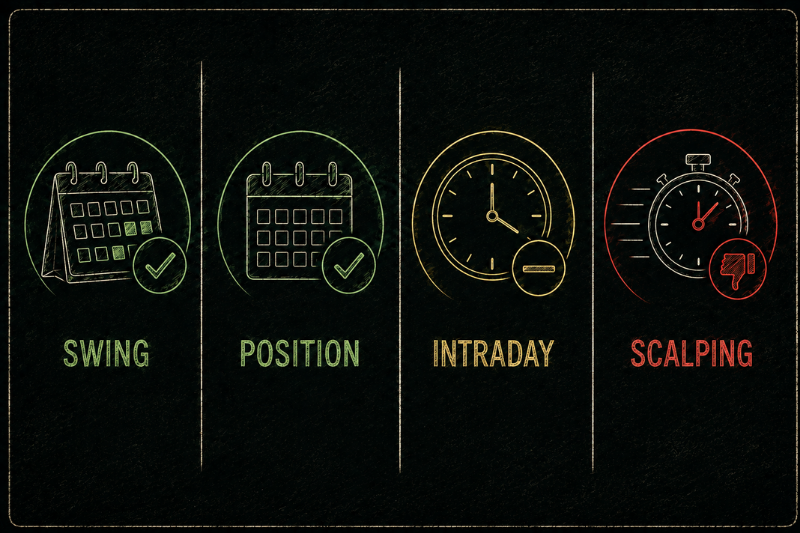
A set and forget strategy works best when trades have enough time to develop on their own. The longer the timeframe, the easier it is to trust the original plan instead of reacting to every market move. While it can be used across different trading styles, some are naturally better suited to this approach than others.
Swing trading
Swing trading is the strongest match for a set and forget strategy. Trades usually last anywhere from a few days to several weeks, giving the market enough time to reach a predefined stop loss or take profit without constant intervention.
Set and forget strategy is particularly helpful for avoiding emotional decisions in swing trading. Instead of watching every candle, traders simply wait for the market to prove the original idea right or wrong.
Position trading
Position trading also fits naturally with a set and forget approach. These trades are designed to capture larger trends and can stay open for weeks or even months.
The biggest challenge in positional trading is patience. Since trades remain open for longer, traders need to be comfortable ignoring temporary pullbacks and sticking to the original plan.
Intraday trading
A set and forget strategy can work for day traders, but it is much harder than using it in swing and positional trading. The rules, process, and execution have to be on point, as the buying and selling happens the same day.
The downside is that intraday markets can become highly volatile around economic news, making active trade management more useful than it would be in swing trading.
Scalping
Scalping is generally the least suitable style for set and forget trading. Scalpers aim for small price movements that often last only a few minutes, so every second can matter.
A trader targeting a five-pip move may need to react immediately if momentum fades or spreads widen. Waiting for the original stop loss or take profit is not always the best decision because market conditions can change very quickly.
Set and Forget trading strategies
Repeatable market structures work well with the set and forget trading approach. Identifying such setups is the core of this trading method and is very crucial to determine entries, stop-losses, and profit targets for a trade.
Let’s look at some practical examples for various setups of set-and-forget trading strategies:
Breakout trades on Hour, Daily, and Weekly Charts
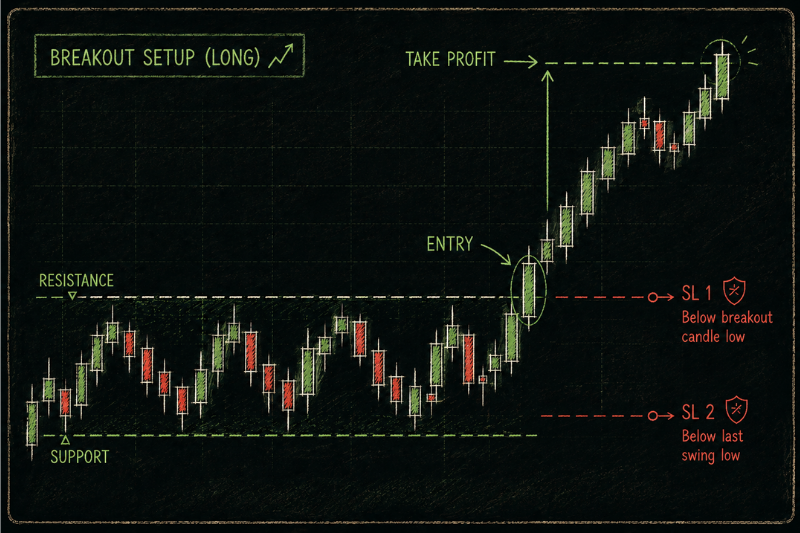
One of the most popular trading setups for set and forget trading is breakout setups. The idea is that once price clears a well-defined level with conviction, it tends to keep moving in that direction rather than reverse immediately. You're trading the expansion that follows a period of consolidation.
Look for the entry point at the breakout of the upper band of consolidation (resistance) for a long trade or the lower band of consolidation (support) for a short trade. Set the stop loss below the breakout candle's low or the last swing low before the break.
Take profit is measured from the height of the prior range projected from the breakout point, or the next major structural level.
Technical indicator trigger trades
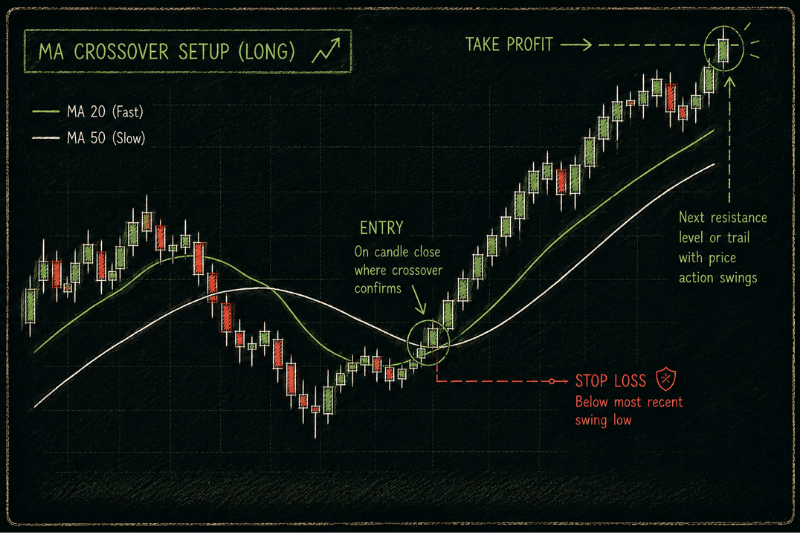
Another set and forget trading setup that is used widely is trades based on triggers from technical indicators like moving average (MA) crossovers or Fibonacci retracements. In an MA crossover, a shorter-period MA like the 9 or 20 crosses above a longer-period MA like the 50 or 200 for a bullish signal, or crosses below for bearish.
Entry is pre-planned on the candle close where the cross confirms, while the stop is set below the most recent swing low for a long trade. Take profit is set at the next resistance and can also be trailed with price action swings.
Support and resistance bounce
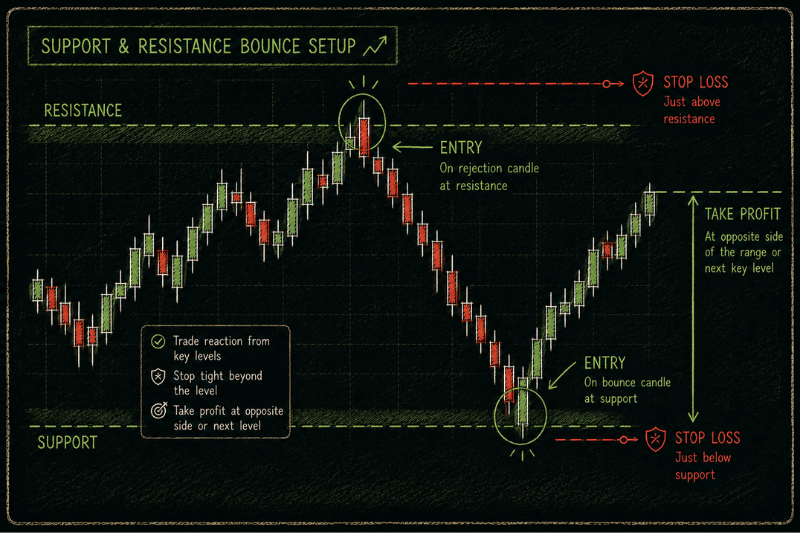
In this setup, a trader is trading a reaction from crucial support and resistance levels. These are key levels that have proven themselves before, betting that it holds again rather than breaks.
Entry is initiated on a rejection candle at the resistance level or a bounce from the support levels, such as a pin bar or engulfing pattern at resistance and a hammer candle at support, rather than blindly buying the level itself. Just beyond these levels, the stop is set, tight enough that a genuine break invalidates the trade quickly.
Take profit can be pre-decided based on RR at the opposite side of the range, or the next significant level in between.
Set and forget trading advantages and disadvantages
Set and forget trading is getting popular for its simple trading process and for reducing emotional decision-making, helping traders trade better with less time invested. While it can help traders, it is not a guaranteed winning system for every trader.
Understanding both its strengths and limitations is essential before relying on it in live financial markets:
How can you test a set and forget strategy before going live?
Backtesting is the fastest way to see whether a set-and-forget setup holds up across dozens of past trades before real money is on the line. Running the same rules through a trading simulator also builds the discipline to leave a trade alone once it goes live.
A trading journal closes the loop, tracking win rate, average risk-to-reward, and how often the plan actually gets a fair test instead of an early exit. Traders preparing for a funded evaluation often lean on this same process to pass a prop firm challenge with a plan they already trust.
A challenge trading account is also a reasonable place to prove a set-and-forget plan under real conditions, since the daily loss limits and drawdown rules force the same discipline a trader should already be practicing. Passing that test with a hands-off strategy says more about the edge than a string of backtested trades ever could.
Final Thoughts
Set and forget trading works best when the important decisions are made before the trade is placed. With a clear entry, stop loss, take profit, and position size already defined, traders are less likely to react impulsively to short-term price movements.
While it won't suit every trading style, it can help traders stay disciplined, reduce unnecessary stress, and focus on consistency rather than constant screen time.
Ready to apply your set and forget strategy to funded capital?
Top One Trader offers Instant Funding, 1-Step, and 2-Step programmes from $5,000 to $300,000, with up to 100% profit splits, low spreads and commissions, and advanced trading platforms suited to scalping, such as TradeLocker.
FAQ
Is set and forget trading profitable?
Yes, it can be profitable if it is backed by a tested strategy, proper risk management, and consistent execution.
Is set and forget trading good for beginners?
Yes, it can help beginners avoid emotional trading, but they still need to learn risk management and trade planning.
What is the best timeframe for set and forget trading?
Swing and position trading timeframes, such as the 4-hour, daily charts, and weekly charts, are generally the most suitable for this approach.
Can you use set and forget trading for day trading?
Yes, but it works best with clear entry, stop loss, and take profit levels planned before entering the trade.
Does set and forget trading eliminate risk?
No, every trade carries risk, which is why stop losses and sensible position sizing remain essential.
-1%201%20(1).webp)