Forex Terminology: Key Terms Every Trader Should Know

Getting these basic forex terms right makes it much easier to read a currency quote, understand what is happening to a trade and see how much money is at risk.
This guide breaks down the main forex trading glossary and uses simple examples along the way, so you can see how they work when placing a trade.
Key Takeaways
- Understanding Forex Terminology helps traders interpret currency pairs, pips, spreads, and leverage, enabling clearer decisions and better risk management.
- Applying Key Terms in Practice improves trading strategy, supports disciplined market analysis, and enhances long-term success in forex trading.
Basics of the Forex Market
Ever wondered why the forex market is so different from stocks or commodities? Its size, liquidity, and forex market participants make it unique, and these basics form the foundation every trader needs to understand. Let's break it down step by step.
Forex Market
The forex market is the largest financial market in the world, with daily trading volumes above $9.5 trillion. It operates 24/5 across global hubs, giving forex traders unlimited opportunities. Unlike stocks, forex trading has no central exchange, making it a truly global and decentralised market.
Liquidity
Liquidity means how easily currencies can be bought or sold without sharp swings. Ultimately, this deep liquidity is what makes forex attractive to traders.
Market Participants
From banks and hedge funds to corporations and retail forex traders, many players drive supply and demand. Central banks are especially powerful, influencing currency trading through interest rates and policy.
Monetary Policy
Think of monetary policy as the steering wheel of the foreign exchange market. Rate hikes usually strengthen a national currency, while cuts often weaken it. Financial decisions frequently reflect efforts to manage inflation, employment, and overall price stability in the economy.
Currency Pairs and Exchange Rates
At its core, forex is about exchanging one currency for another like USD for Japanese Yen. A currency pair consists of a base and a quote. For example, in EUR/USD, the euro is the base and the U.S. dollar the quote. The exchange rate shows their relative value, such as EUR/USD = $1.12 meaning one euro equals $1.12 U.S. dollars.
Major pairs like EUR/USD, GBP/USD, and AUD/USD dominate daily trading volumes with high liquidity and tight spreads. If EUR/USD rises, the euro strengthens against the dollar; if it falls, the euro weakens. This quotation structure helps forex traders identify trends, set entry and exit points, and refine a trading strategy.
Price Influences
Interest rates, GDP growth, unemployment rates, inflation, and geopolitical events all contribute to market volatility. Central banks and government policies also play a major role in shaping currency prices and overall price stability.
Trade Sizes, Units, and Orders
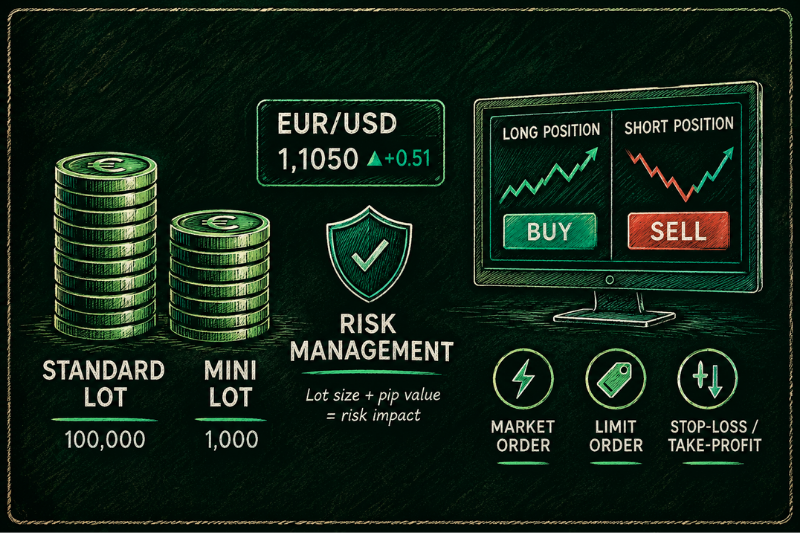
Learning trade sizes and how positions and orders work is very important, because the size of your trade, the smallest price movement (pip), and the type of order you place all determine your profit or loss.
Many beginners overlook this, and it directly affects risk management.
1. Lot Size and Position Sizing
Forex trades are measured in lots: a standard lot equals 100,000 units, a mini lot equals 10,000, and a micro lot equals 1,000. Smaller lots give beginners more control over risk.
Position sizing is just as important; adjusting trade size based on your account balance ensures you don't risk too much on a single trade.
2. Pips and Pip Value
A pip (percentage in point) is the smallest unit of movement in forex, usually the fourth decimal place. For example, if EUR/USD moves from 1.1050 to 1.1051, that's a one-pip change. The value of a pip depends on lot size, with larger lots making each pip movement have a greater impact on profits or losses.
3. Risk Management
Both lot size and pip value tie directly into risk management. Understanding how each price movement impacts your account is critical to surviving in the forex market.
4. Trading Positions (Long and Short)
In forex trading, a long position means buying a currency pair, expecting the base currency to increase in value against the quote. Traders usually go long when they are bullish on the market.
By contrast, a short position means selling a currency pair, anticipating that the base currency will weaken. This allows traders to profit in falling markets.
5. Market Order
A market order executes instantly at the current price. It's the fastest way to enter or exit, though in volatile markets, slippage can occur.
6. Limit Order
Suppose EUR/USD moves toward your chosen price level. A limit order ensures your trade is executed at that level, not just the current market price.
7. Stop-Loss and Take-Profit Orders:
Even traders who have spent a lot of time in markets ignore the stop-loss, which in most cases becomes the cause of continuous losses. Stop-loss and take-profit orders define your entry and exit, protecting your capital and automatically locking in profits.
Leverage, Margin, and Account Balance

Leverage and margin are two of the most powerful and riskiest tools in forex. In other words, they give traders access to much larger positions than their deposit allows, but without proper risk management, they can quickly wipe out an account.
Leverage
Think of leverage as a magnifying glass. It lets traders control large trades with a small deposit. For example, 100:1 leverage means $1,000 can control a $100,000 position. The reality is that this can multiply both profits and losses.
Margin and Margin Call
Margin is the deposit required by forex brokers to open a leveraged trade, acting as a security buffer to ensure you have funds in the game. A margin call happens when your account balance falls below the broker's required margin level, which can lead to open positions being closed automatically unless more funds are added.
Equity
Equity reflects your account's real-time value, including open positions. Monitoring equity closely helps prevent being caught off guard by sudden price movements.
Open Positions
Open positions are trades still active in the market. Keeping track of margin usage, required margin level, and equity across these positions is key to managing account balance safely.
PnL (Profit and Losses)
PnL represents the outcome of your trades. Realised PnL is the profit or loss from closed trades, while unrealised PnL reflects the changing value of open positions as prices move. Together, they show whether your account is gaining or losing money at any moment.
Forex Market Analysis

Trading decisions rely on studying historical price data, using technical analysis tools, and following fundamental analysis of economic events.
Technical Analysis: In practice, technical analysis uses charts and historical forex prices to forecast future moves. Traders rely on price action, such as candlestick patterns, as well as technical indicators like moving averages, RSI, and MACD to identify trends, refine strategies, and pinpoint entry and exit points.
Fundamental Analysis: Fundamental analysis focuses on the bigger picture. Interest rates, unemployment rates, political stability, and geopolitical events often create sharp volatility in forex markets.
Identify Trends: As you might guess, one of the main goals of analysis is to identify trends. Recognising whether the market is trending or ranging helps you apply the right trading strategy.
Price Level: On the other hand, every piece of analysis eventually comes back to the price level. Whether you're using a chart pattern, resistance level, or reacting to news, forex prices guide entry and exit decisions.
Psychology and Risk Management
Many traders fail not because of bad technical analysis or poor understanding of forex prices, but because of emotions. The truth is that psychology and risk management often decide whether you succeed or struggle in trading.
Beginner traders ignore it, but discipline is just as important as any strategy.
Risk/Reward Ratio
The risk/reward ratio compares potential profit with potential loss. By sticking to positive ratios, traders can survive long-term even with average win rates.
Stop-Loss Orders
Stop-loss orders are an order type that closes the position at an instructed price. They work like a trader’s safety net and protect against unexpected moves and enforce discipline, taking emotions out of the decision.
Emotional Decision Making
Fear and greed are the biggest enemies of a trader. Emotional decision-making often leads to errors, while staying calm and logical keeps your trading strategy intact.
Revenge Trading
Revenge trading is when traders place impulsive or high-risk trades to recover losses from previous trades. Among the top trading mistakes, revenge trading is one of the costliest mistakes. Chasing losses by placing impulsive trades usually compounds errors and drains your account balance.
Fear and Greed
Fear often leads traders to close winning trades too early or avoid good setups, while greed pushes them to over-leverage, ignore stop-losses, or chase the market. Both emotions cause emotional decision-making instead of following a trading strategy. Managing fear and greed with discipline and risk management is essential for long-term success.
Additional Trading Terms to Know
Beyond the basics, forex has additional terms that shape costs, strategies, and real-world trading decisions. Knowing about CFDs, carry trades, and spreads can save you from costly surprises.
CFDs (Contracts for Difference): CFDs let you speculate on currency prices without owning the actual asset. They offer flexibility but also add fees and leverage risks.
Swap and Rollover: Holding a trade overnight often triggers a swap or rollover. Depending on the interest rate differences, you'll either pay a fee or receive a credit.
Spread: The spread is the difference between the bid (sell) price and the ask (buy) price. It represents the basic cost of entering a trade. Active forex traders prefer tighter spreads because they lower overall costs and make short-term strategies more efficient.
Trading Costs: Beyond the spread, traders also face other costs such as swaps, commissions, and slippage. These additional trading costs directly affect account balance and profitability. Factoring them into your risk management and trading strategy is essential to ensure that profits remain sustainable after expenses.
Conclusion
Learning forex terminology is the first step to trading with confidence. By understanding key concepts like currency pairs, lots, pips, leverage, and margin, you gain the tools to interpret price movements and manage risk effectively. Beyond definitions, strong market analysis and disciplined risk management ensure strategies remain sustainable.
Just as important are psychology, patience, and discipline, which often decide whether traders succeed or fail. Whether you're starting out or sharpening your skills, applying this knowledge in practice will help you trade smarter, avoid costly mistakes, and build a solid foundation for long-term success in the forex market.
Ready to put your knowledge into action? Join Top One Trader today and get access to educational content, flexible funded accounts up to $500,000, advanced trading platforms, and a supportive trader community with 24/7 assistance. Start your journey with confidence.
FAQs
What is a pipette in forex?
A pipette is a fractional pip, typically representing one-tenth of a pip, and allows brokers to quote currency prices with greater precision.
What is the bid price in forex?
The bid price is the price at which a trader can sell a currency pair, while the ask price is the price at which the trader can buy it.
What is slippage in forex trading?
Slippage occurs when a trade is executed at a different price than the one expected, often because of rapid price movements or limited liquidity.
What is a cross currency pair?
A cross currency pair is a forex pair that does not include the U.S. dollar, such as EUR/GBP or AUD/JPY.
What is an exotic currency pair?
An exotic currency pair combines a major currency with the currency of an emerging or smaller economy, such as USD/TRY or USD/ZAR.